
Season 1: New York City
The Ship in the Harbor
Summary
In September 1609 men fishing off this coast saw something enormous floating far out on the water. It was the Halve Maen, a small ship of the Dutch East India Company under Henry Hudson, an Englishman. The Company’s merchants had argued over whether the voyage was worth sending at all: the prize was a northern sea route to China and the Spice Islands, the Zeeland chamber called it money thrown away, and Amsterdam went ahead for fear that a rival would hire Hudson first. Hudson sailed late, met the ice off Nova Zembla, and then broke his orders and turned west. On September 3 the ship came to three great rivers, turned away from a shallow bar, and anchored in the harbor. For two days the people of the country came aboard and traded green tobacco for knives and beads, each side working out what the other one was.
Chapters
Then and now
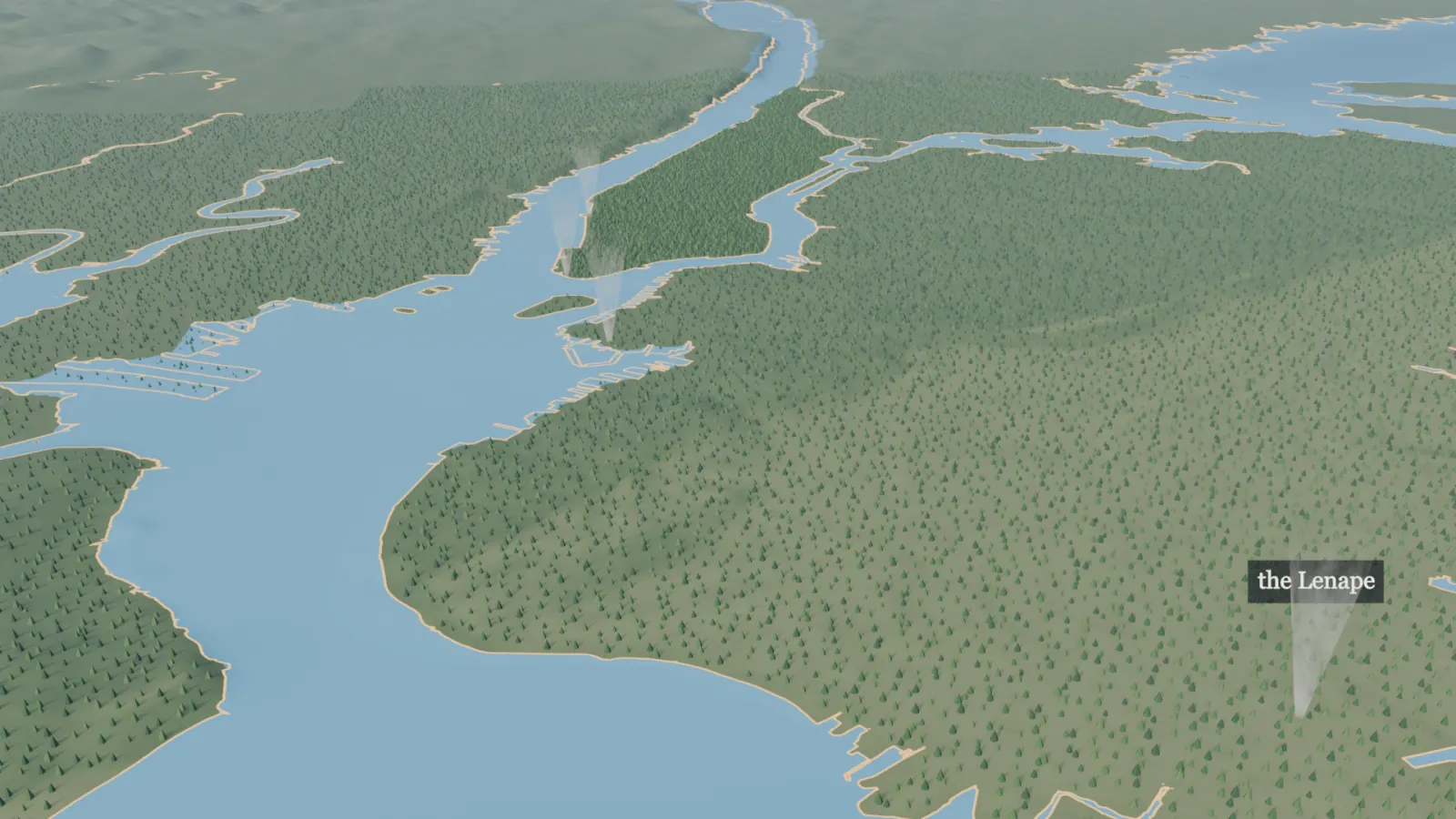
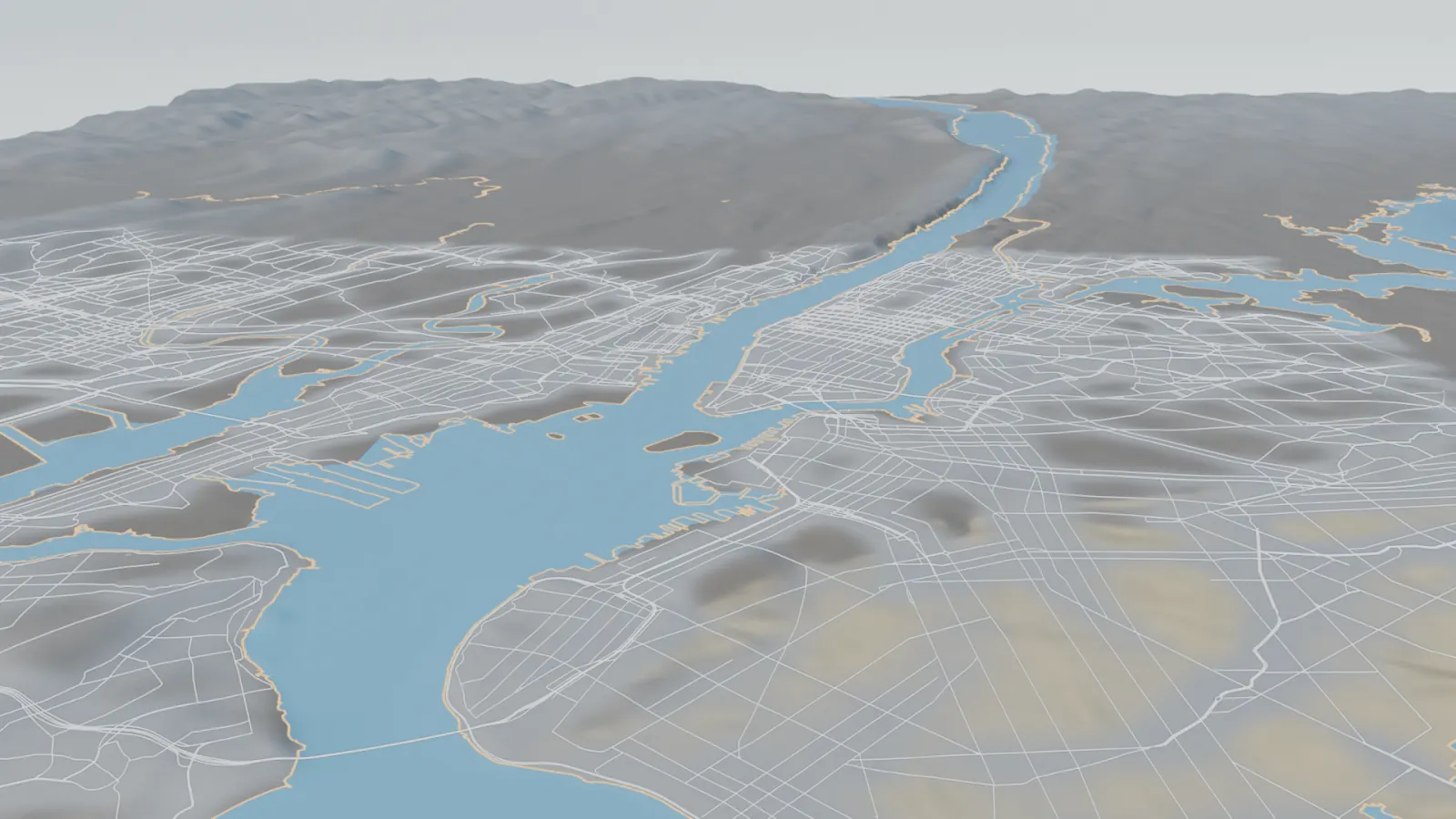
Animated reconstructions from the episode, built on elevation data and today's shoreline.
The map
Transcript
The full narration. Select a time to play from that moment. Each small number leads to the sources for that passage. Plain text version
The floating house 0:00
0:07Some Lenape people were out fishing at a place where the sea widens.1 It lay off the harbor where New York City stands today, and the year was 1609.2 Far out on the water, they saw something remarkably large floating.3 Some of them believed it was an uncommonly large fish or animal. Others said it must be a very big house, floating on the sea.3 About two centuries later, Lenape people were still telling the story of that day.4
0:38On board the floating thing, a small crew was looking back at the shore. They had a question of their own: whether the people of this coast could be trusted.5 None of them had planned to come here. Their ship had been sent to find a sea route to China, by way of the northeast.6 Her story began in Amsterdam that January, with a company ready to take a gamble.7
The race for spices 1:02
1:02The company was the Dutch East India Company, a trading company owned by shareholders.8 It was formed in 1602 from several Dutch companies that had been racing each other for the spice trade.9 That race had pushed up the price of spices in the East Indies, the islands that gave the Company its name.10 Pepper came from large islands like Java and Sumatra. But cloves and nutmeg grew on only a few of the Moluccas, a group of more than a thousand islands.9 Whoever controlled those few islands controlled the trade. That control made nations rich, and started wars.9
1:40The Dutch government had given the Company a charter, a written grant of rights.11 It could sail to the East Indies by two routes only.12 One went around the Cape of Good Hope, at the tip of Africa. The other went through Magellan’s Straits, a sea passage at the tip of South America.12 A voyage around the Cape, out and home, generally took three years, and ships might have to fight the Portuguese.13 The strait was no faster. The first Dutch fleet to come home that way took three years, and only one of its four ships made it back.14
2:17Isaac Le Maire was a wealthy Amsterdam merchant who had been one of the Company’s first directors.15 Then he left it, and started his own voyages to break its monopoly, its sole right to the trade.16 Now he and a geographer named Petrus Plancius had a bigger idea.17 Ships could sail north, past the ice, to China, Japan and the Spice Islands.13 The whole voyage could be done in six months, they said, without passing a single fort of the king of Spain.13
2:49A shortcut like that would pull investors away from the old Company and into a new one.11 The old one could not even complain, because its charter did not cover the north.11 Le Maire needed three or four thousand crowns.11 He could not raise it openly in Holland, because the Company must not hear of the plan.18 But the king of France had already sent his envoy to Le Maire, to talk about the spice trade. So Le Maire asked the king for the money.19
3:18Henry Hudson was an Englishman who had twice sailed north to look for that passage.20 That winter, the Company had paid him for his trouble and sent him away, with a promise of work in 1610.21 Le Maire knew Hudson, and met him in secret.22 When some of the Company’s men heard, they feared Le Maire would hire him.23 So the Company offered Hudson a voyage in 1609, a year early.24
3:44The Company had six chambers, its offices in six Dutch cities. Each had its own directors and its own share of the money.25 Amsterdam’s chamber put up half the money, and this plan was Amsterdam’s.26 It asked the other chambers to approve, and said it would send Hudson at its own risk if they refused.23 That year, the Zeeland chamber was in charge of the whole Company, so its answer mattered most.12 It did not refuse. But it called the voyage a matter for private men, and money “thrown into the water,” wasted.12
Amsterdam takes the gamble 4:23
4:23Amsterdam took the gamble anyway. On January 19, it voted Hudson 150 guilders, in Dutch money, toward his wages.27 Its clerk wrote his name the Dutch way, “Tomas Hutson.”28
4:38Le Maire and Plancius had warned that a northern voyage must start by March, or the winter would catch it.13 On April 6, 1609, Hudson sailed from the Texel, an island off the Dutch coast.29 He was already late.30
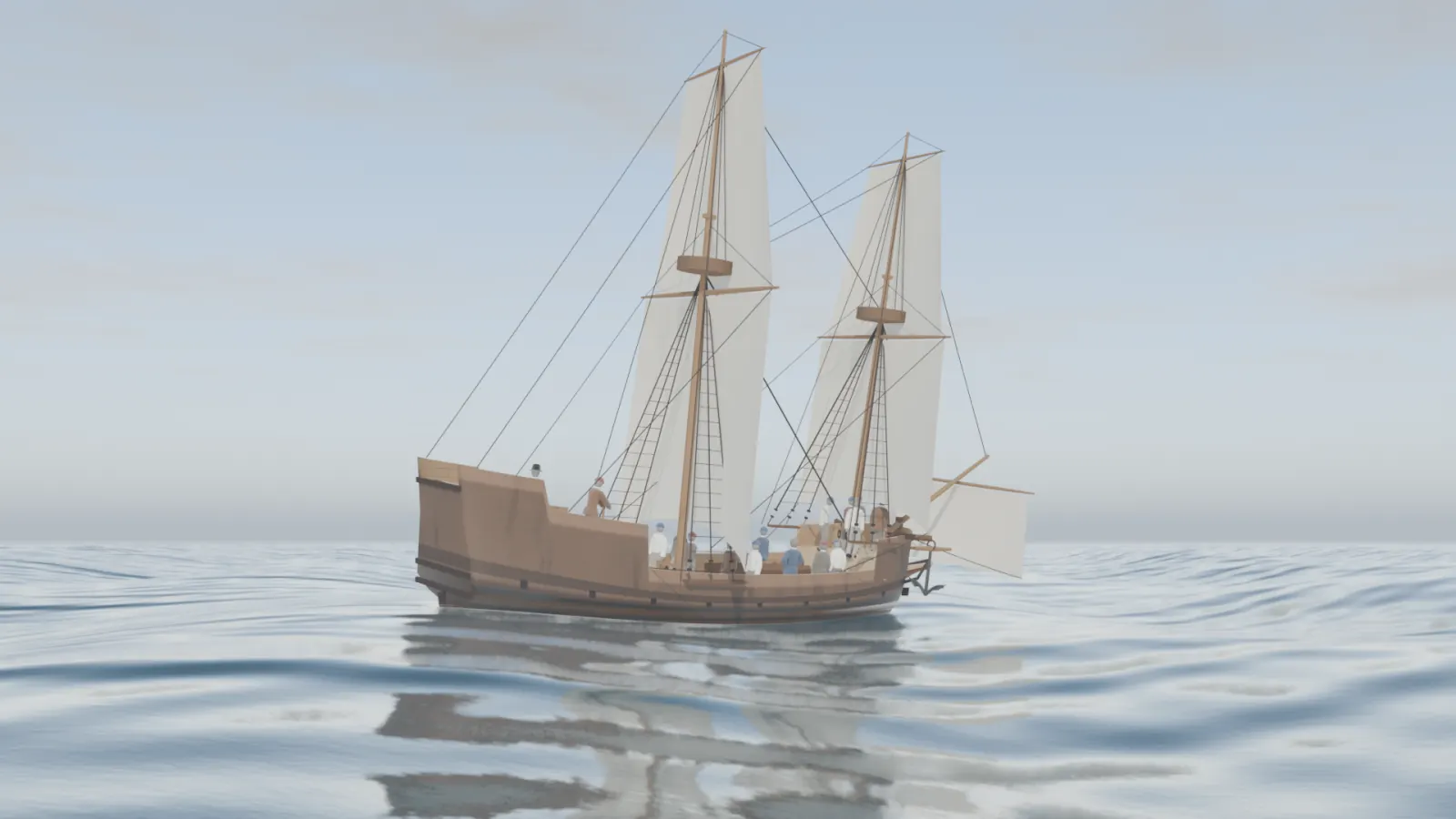
4:54The thing the fishermen saw was neither a fish nor a house. It was a ship.31 Still, a house that floats was closer than it sounds.3 She was the Halve Maen, Dutch for Half Moon.32 She was a yacht, a small ship, of a type called a vlieboot, with a rather flat bottom for sandy Dutch waters.33 The Company’s ship book listed her at forty lasts, about 80 tons of cargo.34
5:22In 1608, the Company ordered a yacht about 65 feet long and 15 feet wide.35 Her hold, the cargo space below, was about 7 feet deep.35 She had three masts and six sails, and a cabin at the back, behind the mizzen, the rear mast.35 On ships of the time, the cabin at the back was for the men in charge, so this one was probably Hudson’s.36 That order may have covered yachts of her kind in general, not only this one.35
5:52The rest is how ships like her were usually fitted out.37 The cook worked in the forecastle, the front of the ship. He made his fire on a hearth of tiles, a floor of tiles that kept it off the wooden deck.37 The helmsman steered with a whipstaff, a tall pole, not a wheel.37 He pushed the top of the pole to one side. Below him, it swung the tiller, a handle fixed to the rudder, and the ship turned.38 The crew had no rooms. Men slept on the floor of a deck below.37 A Company crew usually ate salted meat and sea biscuit.9 Each man drank about a litre and a half of water or beer a day.9
6:33Eighteen or twenty men, partly English and partly Dutch, would live in that space for months.39 She carried two boats, a larger boat and a small one called a scute. She had muskets, and two small guns that fired stones, called murderers.40 Hudson was her master, the man in command, and her merchant, handling the Company’s trade.41 Robert Juet, one of the crew, kept the log, the ship’s daily record.42
Ice, and a turn west 7:02
7:01Their orders were to sail around the north side of Nova Zembla, a land of ice in the far northeast.43 They found the sea there full of ice.44 Men who had served the Company in the East Indies could not bear the cold, and quarrels broke out.39 If the northeast failed, Hudson’s orders were to come home.45
7:22Instead of turning home, Hudson put a new plan to his crew. An English friend, Captain John Smith, had sent him letters and maps from the new English colony in Virginia.44 They showed a sea north of that colony, leading to the ocean beyond America. That would be a short way to the East Indies.44 So, against his orders, Hudson turned the ship west.46 The Company had paid for a voyage to the northeast. Its yacht was now sailing west.47
7:55Behind them, Le Maire had found his money. His ship, paid for by France, sailed about a month after Hudson, on the northern route.48 It came home with nothing to report.49
8:07In July, the Half Moon put in on the coast of what is now Maine, near Penobscot Bay. She needed a new foremast, her front mast.50 On July 17, six local people came out in two boats. They seemed glad to see the ship, and they ate and drank with the crew.51 One of them spoke some words of French, because French traders came there every year.52 The crew went ashore and cut one.51 Then the people brought beaver skins and fine furs to trade.51
8:36The crew kept watch, for fear the people would turn on them.51 On the morning of July 25, they struck first. Six men with muskets took one of the people’s boats.40 Then twelve men, with muskets and the two murderers, drove the people from their houses and took their belongings.53 The people they robbed had come to trade.52 The next morning, the ship went out to sea.40
Three great rivers 9:00
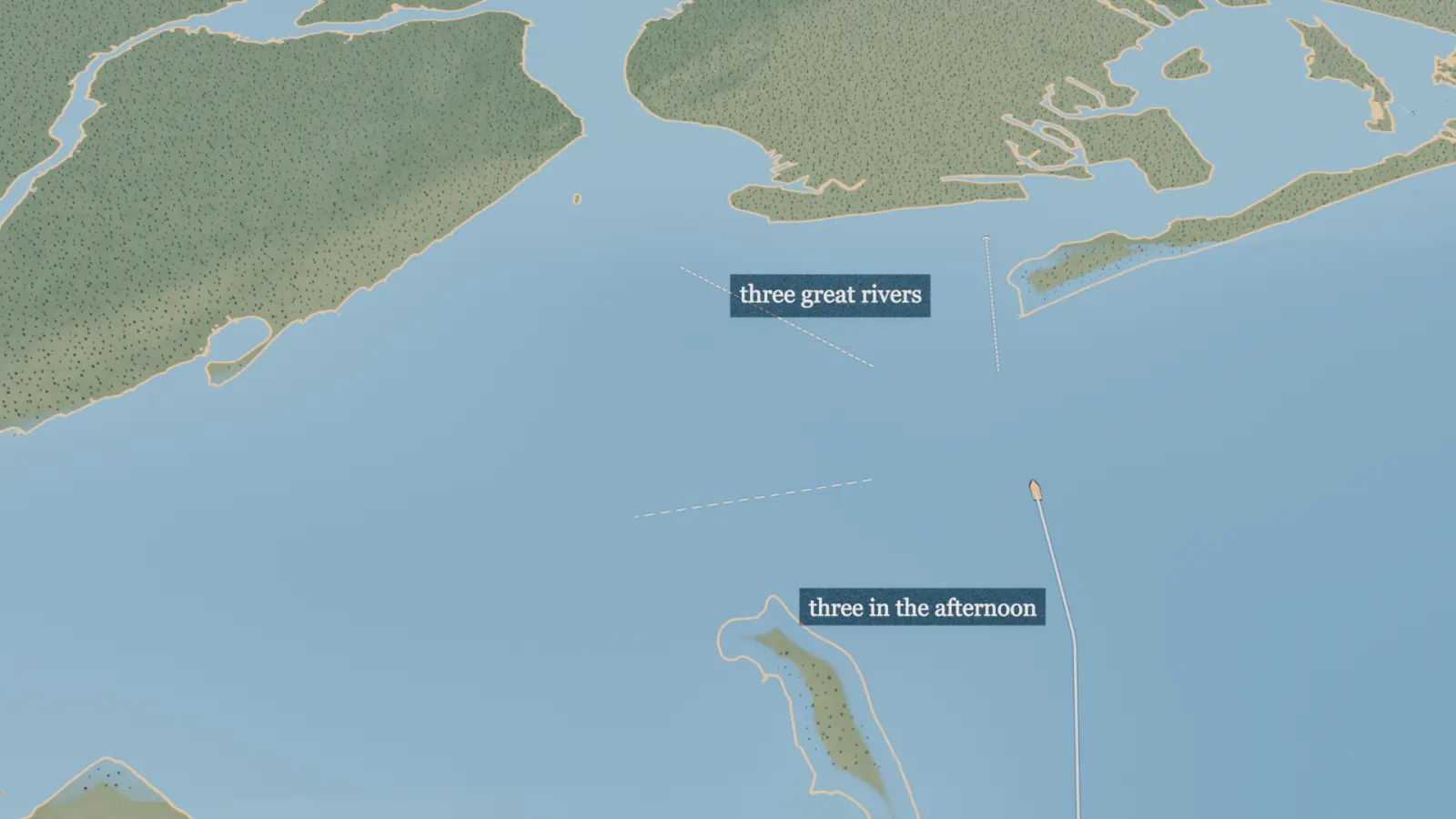
9:00She sailed south along the coast.50 On the afternoon of September 3, she came to “three great Rivers.”54 The crew tried the northernmost first. A shoal bar, a bank of sand under the water, lay before it with only ten feet of water.54 So they turned south, came in by the southern side, and anchored in five fathoms, about 30 feet of water.54 Salmon and mullet swam around the ship, with some very great rays.54 The Company had sent her to find a passage to China. She had found a harbor full of salmon.55
9:35The fishermen had seen the ship first. Lenape warriors came to look, and saw it moving toward the mouth of the river.56 They decided it was a great house, and that their Mannitto, a great spirit, was inside it, coming to visit them.56 The chiefs gathered on Manhattan to decide how to receive him. The women were asked to prepare the best food.3
9:58On September 4, people from the shore came out to the ship and climbed aboard.57 They seemed very glad that she had come. They brought green tobacco, and traded it for knives and beads.57
10:11The Lenape were most struck by one man, who wore a red coat all glittering with gold lace.58 They thought he must surely be the great Mannitto. But they could not explain why he should have a white skin.58 Juet looked the people over just as closely. They wore deer skins, loose and well dressed.57 They had yellow copper, and plenty of corn for good bread. They were very polite, and they wanted clothes.57
Watching each other 10:38
10:38On one side, the question was whether a god had come. On the other, it was what these people had, and what they wanted.59
10:48On September 5, many people came aboard.57 Some wore mantles of feathers, and some wore skins of good furs. They had tobacco pipes of red copper.57 The ship had eighteen or twenty men, and her deck was full of strangers.5 At night the people went home, and the ship rode quietly at anchor. The crew still did not trust them.57
11:12The morning of September 6 was fair.57 Hudson sent John Colman, one of his crew, with four other men in the ship’s boat.57 The other river lay four leagues away, on the north side of the bay.57 A league was a little more than three miles.60 They were to row across and sound it, measuring how deep its water ran.57
11:33For two days, the two peoples had traded and watched each other.57 Now five men rowed away into a harbor they did not know. Before the boat found the ship again, one of the five would be dead.61 It would be John Colman.61
How We Know
Every line of this episode rests on a source. The episode draws on 13 works, listed here by kind, and the notes after them show which source supports each passage of the transcript, with page numbers where the source has them. Where the sources fall silent, the animation makes a setting choice and labels it on screen.
Primary sources
Records written at the time, and a Lenape tradition written down by a missionary.
- G. M. Asher, ed., Henry Hudson the Navigator (1860). Read a free copy: Asher 1860
Supports 49 passages in the transcript. - J. Franklin Jameson, ed., Narratives of New Netherland, 1609 to 1664 (1909), for Emanuel van Meteren and Robert Juet. Read a free copy: Jameson 1909
Supports 45 passages in the transcript. - Henry C. Murphy, Henry Hudson in Holland, ed. Wouter Nijhoff (1909). Read a free copy: Murphy 1909
Supports 21 passages in the transcript. - John Heckewelder, History, Manners, and Customs of the Indian Nations, ed. W. C. Reichel (1881). Read a free copy: Heckewelder
Supports 13 passages in the transcript. - Henry C. Murphy, Henry Hudson in Holland (1859). Read a free copy: Murphy 1859
Supports 8 passages in the transcript.
Scholarship and science
Later histories, field studies and geological surveys.
- W. H. Smyth, The Sailor’s Word-Book: An Alphabetical Digest of Nautical Terms, revised by Sir Edward Belcher (London: Blackie and Son, 1867). Read a free copy: Smyth 1867
Supports 2 passages in the transcript.
Reference and public institutions
Public agencies, museums, Lenape institutions and reference works.
- Hudson River Maritime Museum, “Building & Sailing the ‘Half Moon’” (2020).
Supports 8 passages in the transcript. - Western Australian Museum, “VOC: United Dutch East India Company”.
Supports 6 passages in the transcript. - Union College news (2004).
Supports 4 passages in the transcript. - New Netherland Institute, “Olivier van Noort: The First Dutch Circumnavigator”.
Supports 1 passage in the transcript. - Wikipedia, “Olivier van Noort”.
Supports 1 passage in the transcript. - Batavialand, Lelystad, VOC ship reconstruction pages. Read the page: Batavialand, Lelystad, VOC ship reconstruction pages
Supports 1 passage in the transcript. - Wikipedia, “Whipstaff”.
Supports 1 passage in the transcript.
Notes: which source supports each passage (61)
- Heckewelder, pp. 71 to 72; p. 71 ↩
- Heckewelder, p. 71; Jameson 1909 (Robert Juet), p. 17 ↩
- Heckewelder, pp. 71 to 72 a b c d
- Heckewelder, p. 71 ↩
- Asher 1860, pp. 147 to 148; Jameson 1909, p. 6; Murphy 1909, p. 119; Jameson 1909 (Robert Juet), p. 18 a b
- Jameson 1909 (Emanuel van Meteren), p. 3; Asher 1860, pp. 248 and 250 ↩
- Asher 1860, pp. 252 to 253; Murphy 1909, pp. 112 and 114 to 115 ↩
- Jameson 1909 (Emanuel van Meteren), p. 3; Murphy 1909, pp. 112 and 114 to 115 ↩
- Western Australian Museum, VOC: United Dutch East India Company a b c d e
- Western Australian Museum, VOC: United Dutch East India Company; Asher 1860, pp. 252 to 253 ↩
- Asher 1860, pp. 249 to 250 a b c d
- Murphy 1909, pp. 112 and 114 to 115 a b c d
- Asher 1860, pp. 248 and 250 a b c d
- New Netherland Institute, Olivier van Noort: The First Dutch Circumnavigator; Wikipedia, Olivier van Noort ↩
- Asher 1860, pp. 244 to 245 and 253 to 254; Murphy 1909, p. 8 ↩
- Murphy 1909, p. 8 ↩
- Asher 1860, pp. 248 and 250; Murphy 1909, pp. 112 to 113 ↩
- Asher 1860, pp. 249 to 250; p. 244 ↩
- Asher 1860, p. 244; pp. 244 to 245 and 253 to 254; pp. 249 to 250 ↩
- Asher 1860, pp. 244 to 245 and 253 to 254; Jameson 1909 (Robert Juet), pp. 11 to 28 ↩
- Asher 1860, pp. 244 to 245 and 253 to 254 ↩
- Asher 1860, pp. 244 to 245 and 253 to 254; pp. 252 to 253 ↩
- Asher 1860, pp. 252 to 253 a b
- Asher 1860, pp. 252 to 253; pp. 244 to 245 and 253 to 254 ↩
- Murphy 1909, p. 15 ↩
- Murphy 1909, p. 15; pp. 114 to 115; Asher 1860, pp. 252 to 253 ↩
- Murphy 1909, pp. 114 to 115; pp. 112 and 114 to 115 ↩
- Murphy 1909, pp. 114 to 115 ↩
- Jameson 1909 (Emanuel van Meteren), p. 3 ↩
- Asher 1860, pp. 248 and 250; Jameson 1909 (Emanuel van Meteren), p. 3 ↩
- Heckewelder, pp. 71 to 72; Jameson 1909 (Emanuel van Meteren), p. 3 ↩
- Jameson 1909 (Emanuel van Meteren), p. 3; Asher 1860, p. 154; Murphy 1859, pp. 33 to 34 ↩
- Murphy 1859, pp. 34 to 36; Murphy 1909, pp. 110 to 111; Asher 1860, p. 147 ↩
- Asher 1860, p. 254; Jameson 1909, p. 6 ↩
- Hudson River Maritime Museum, Building & Sailing the ‘Half Moon’ (2020) a b c d
- Batavialand, Lelystad, VOC ship reconstruction pages; Asher 1860, p. 154; Murphy 1859, pp. 33 to 34 ↩
- Hudson River Maritime Museum, Building & Sailing the ‘Half Moon’ (2020); Union College news (2004) a b c d
- Wikipedia, Whipstaff ↩
- Asher 1860, pp. 147 to 148; Jameson 1909, p. 6; Murphy 1909, p. 119 a b
- Asher 1860, p. 61 a b c
- Asher 1860, p. 154; Murphy 1859, pp. 33 to 34; Smyth 1867 ↩
- Jameson 1909 (Robert Juet), pp. 11 to 28 ↩
- Murphy 1859, pp. 34 to 36; Murphy 1909, pp. 110 to 111; p. 119; Asher 1860, pp. 147 to 148; Jameson 1909, p. 6 ↩
- Jameson 1909 (Emanuel van Meteren), pp. 6 to 7 a b c
- Asher 1860, p. 154; Murphy 1859, pp. 33 to 34 ↩
- Asher 1860, p. 154; Murphy 1859, pp. 33 to 34; Jameson 1909 (Emanuel van Meteren), pp. 6 to 7 ↩
- Asher 1860, p. 154; p. 149; Murphy 1859, pp. 33 to 34; Jameson 1909 (Emanuel van Meteren), p. 7 ↩
- Murphy 1909, p. 8; pp. 8, 28 and 29 ↩
- Murphy 1909, pp. 8, 28 and 29 ↩
- Asher 1860, p. 149; Jameson 1909 (Emanuel van Meteren), p. 7 a b
- Asher 1860, pp. 59 to 61 a b c d
- Asher 1860, pp. 59 to 61; p. 149; Jameson 1909 (Emanuel van Meteren), p. 7 a b
- Asher 1860, p. 61; p. 149; Jameson 1909 (Emanuel van Meteren), p. 7 ↩
- Jameson 1909 (Robert Juet), p. 17 a b c d
- Jameson 1909 (Emanuel van Meteren), p. 3; Asher 1860, pp. 248 and 250; Jameson 1909 (Robert Juet), p. 17 ↩
- Heckewelder, p. 72 a b
- Jameson 1909 (Robert Juet), p. 18 a b c d e f g h i j k l
- Heckewelder, pp. 73 to 74 a b
- Heckewelder, pp. 73 to 74; Jameson 1909 (Robert Juet), p. 18 ↩
- Smyth 1867 ↩
- Jameson 1909 (Robert Juet), pp. 18 to 19 a b